


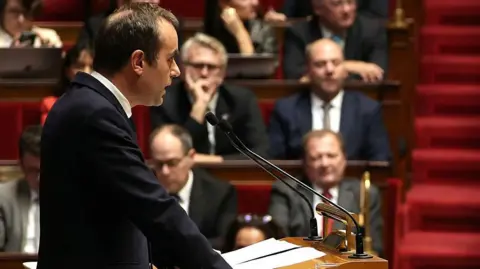
French Prime Minister the government leader has told the National Assembly that he supports suspending contentious 2023 pension reforms, ahead of important censure votes later this week.
The changes, which increased the retirement age from 62 to 64, were seen as defining measures in President Macron's administration.
"This autumn I will suggest to parliament that we freeze the 2023 pension reform until the next presidential vote," Lecornu declared to support from progressive factions.
The Prime Minister was returned to office last week only four days after he resigned, and must secure the support of progressive representatives in parliament if his cabinet is to remain in power.
Parliamentary Dynamics
Political rivals on the right-wing and far left have called no-confidence motions on the cabinet, for midweek and are calling for parliamentary elections.
The Socialist party stated they would be willing to support the cabinet, but only if it guarantees a total halt of Macron's retirement reforms.
"Should he fail to directly announce the words 'full and instant freeze of the pension reform', it will be censure," Socialist MP Laurent Baumel said earlier on French TV.
"He is holding his destiny in his own hands. He understands what he has to do if he wants to avoid being the government leader who leaves office every week."
Reform Background
The measures were eventually passed by lawmakers in spring 2023, under a year after the president was returned for a re-election.
There had been an extended period of political debate, strikes and civil unrest, and in the end the bill had to go through without a formal consent in the assembly using a government tool known as constitutional article 49-3.
Days ago, the Prime Minister said it was something many citizens remembered as a "political scar" .
Financial Implications
On this week he clearly stated to representatives that halting the retirement changes would amount to millions in 2026 and a additional €1.8bn in the presidential election year. This will have to be "balanced with other reductions," the Prime Minister stated.
The Prime Minister is the country's third prime minister in the last twelve months but even if he manages to stay he needs to secure approval for a budget through parliament that reduces a financial shortfall estimated to reach 5.4% of GDP this year.
The country's public debt earlier this year amounted to trillions, or nearly 114% of GDP, the third biggest in the eurozone after Greece and Italy.
Government Calculations
The Prime Minister has been one of the president's staunchest allies, so his choice to change direction on such a divisive reform shows how keen the head of state is to avert more political crisis.
A Nobel laureate, who was co-recipient of the prestigious award on this week, said earlier that he also backed a halt of the pension reform, because it would still represent a reduced impact than the instability that would result from another cabinet dissolution.


